Emirates
COMPASS Test
Aptitude
2026
Emirates COMPASS Test 2026 — Modules, Difficulty & How to Prepare
March 2026
14 min read
FlightDeckIQ
If you make it to the Dubai assessment phase of Emirates pilot selection, you've already passed the HireVue, cleared online psychometrics, and survived the MS Teams panel interview. COMPASS is the next gate — and for many candidates, it's the last one they clear.
The COMPASS test has one of the highest candidate attrition rates in the entire Emirates selection process. Pilots with thousands of flying hours, strong technical knowledge, and impressive careers fail it every cycle. Not because they're poor pilots, but because they arrived unprepared for what it actually measures.
This guide breaks down every module, explains what the test is really assessing, identifies the specific failure modes that sink candidates, and gives you a concrete preparation strategy for each sub-test.
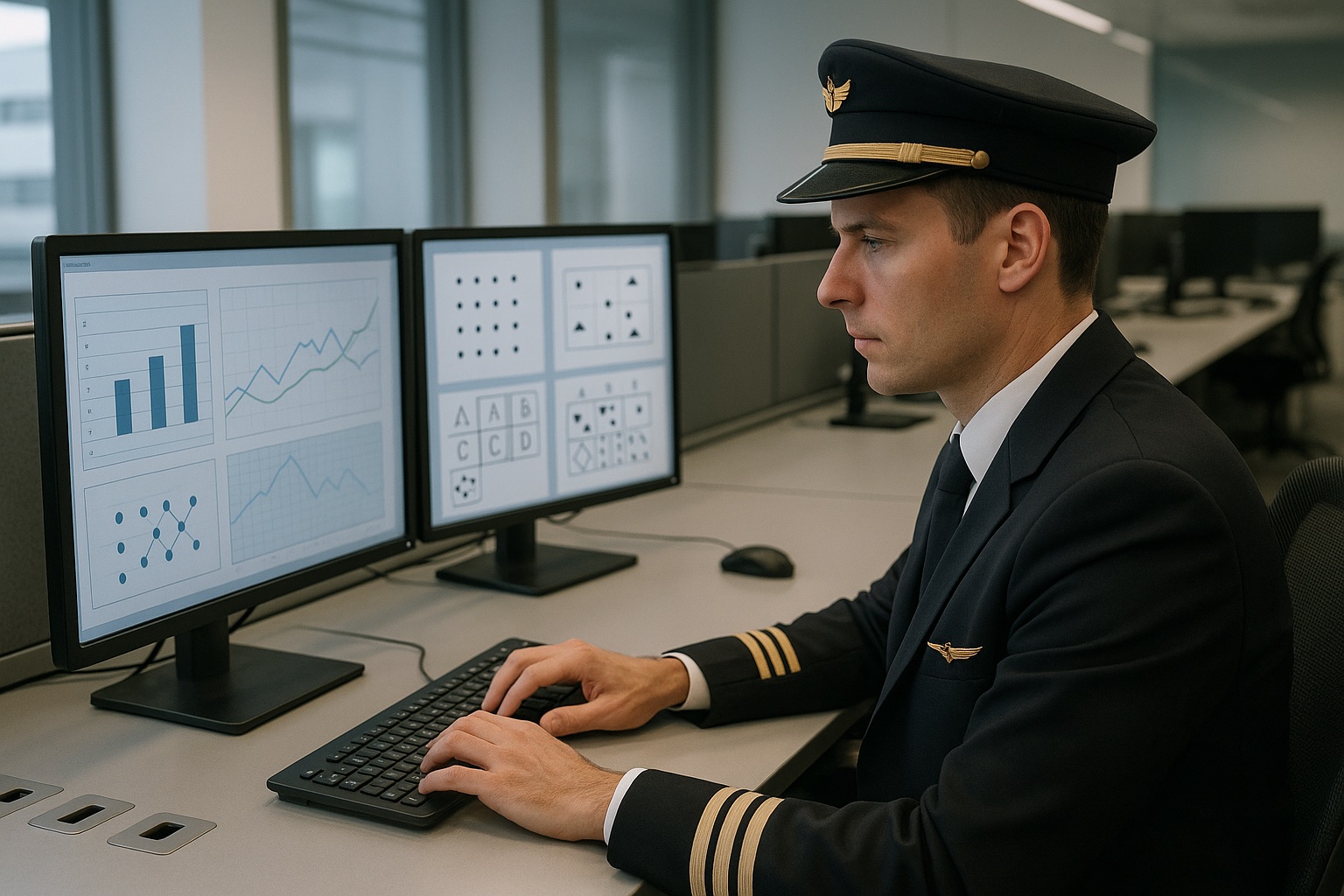
COMPASS stands for Computerised Pilot Aptitude Screening System. It is a computer-based cognitive test battery developed specifically for pilot selection. Emirates administers it in person during the Dubai assessment phase — you cannot take it remotely.
The test runs for approximately 2.5 to 3 hours and consists of six distinct sub-tests, each measuring a different cognitive domain relevant to professional flight operations. The assessment is norm-referenced, which means your score is compared against other pilot candidates — not against an absolute threshold. Emirates has not publicly disclosed the exact pass score or percentile cutoff.
Critically, COMPASS is not a knowledge test. It does not test your ATPL theory, your SOP knowledge, or your type rating currency. It tests the underlying cognitive architecture that makes a pilot effective under pressure — the ability to process information simultaneously across multiple streams, maintain spatial awareness under cognitive load, and keep working memory functioning when other tasks are competing for bandwidth.
Most pilots who reach the Dubai assessment are operationally excellent. They fly well, they know their aircraft, and they've prepared thoroughly for the CBI questions. What many of them haven't done is train the cognitive skills that COMPASS specifically measures.
There are two structural reasons why attrition is high:
First, the dual-task demand is genuinely hard. Many COMPASS modules require you to perform two cognitively demanding tasks simultaneously — tracking a moving target while monitoring a separate information stream, or maintaining a sequence in working memory while processing new inputs. Most candidates have never trained dual-task performance deliberately. It's a skill that feels alien at first and improves dramatically with practice.
Second, candidates underestimate how fast the difficulty escalates. COMPASS sub-tests are designed to find your ceiling, not just confirm a baseline. The difficulty increases progressively within each module. Candidates who haven't practised with the specific format hit the wall earlier than they expect — and because there's no going back to easier items, the ceiling they hit defines their score.
You are shown aircraft attitude displays, VOR/RMI indicators, or 3D representations of aircraft position and must identify the correct orientation. The task escalates from simple attitude recognition to complex multi-axis spatial reasoning. Some variants require you to mentally rotate a perspective or interpret a situation from the perspective of someone in a different position.
Difficulty driver: Speed and accuracy must both be maintained. Slow and accurate is not enough — the test is timed and item progression depends on performance.
The single highest-attrition module in most cohorts. You are required to perform two or more concurrent tasks — typically a tracking or monitoring task running in the background while a separate cognitive task demands active attention in the foreground. Performance degrades rapidly without practice because the human brain's natural tendency is to serialise tasks rather than parallelise them.
Difficulty driver: Most candidates have never deliberately trained dual-task performance. First exposure to this format during a high-stakes assessment produces poor results.
Sequences of items — numbers, letters, symbols, or positions — are presented and must be recalled accurately after a delay or additional processing. The working memory module adds concurrent cognitive load to increase difficulty: you don't simply store and recall, you store, process another task, and then recall the original sequence accurately.
Difficulty driver: Interference from concurrent tasks. Working memory capacity under zero load is much higher than under concurrent cognitive demand. This gap is what the test exploits.
Pattern recognition under time pressure. Sequences of shapes, symbols, or matrices are presented and you must identify the rule governing the sequence and apply it to select the correct completion. The patterns escalate from straightforward to multi-variable rules that require maintaining several dimensions of logic simultaneously.
Difficulty driver: Time pressure. Most candidates can solve the items given enough time — the constraint is identifying the pattern faster than the clock runs.
Aviation arithmetic under time pressure — speed/distance/time calculations, fuel arithmetic, unit conversions, and proportional reasoning. The mathematics itself is not beyond standard ATPL level, but the speed requirement and the fact that it runs concurrently with other cognitive fatigue from earlier modules create difficulty.
Difficulty driver: Fatigue and speed. By the time you reach this module in a 3-hour battery, cognitive reserves are depleted. Practising under fatigue conditions is important.
A tracking task that requires precise control inputs to keep a cursor or indicator within a target zone. The task is deliberately designed to require continuous micro-corrections rather than gross movements — simulating the precision demands of instrument flight. It may be combined with a concurrent cognitive task to increase difficulty.
Difficulty driver: Many candidates over-correct. The instinct is to make larger, faster corrections — but the optimal strategy is small, smooth, anticipatory inputs. This is a trainable skill.
FlightDeckIQ
FlightDeckIQ's modules are built to match each COMPASS domain — spatial orientation, dual-task multitasking, working memory, and more. Train the specific cognitive skills the test actually measures.
Try COMPASS Practice Free →After working with pilots preparing for the COMPASS test, the same failure patterns come up consistently:
Almost every candidate who reviews their Dubai assessment afterwards identifies the multitasking module as the one that surprised them most. The format is genuinely unlike anything in normal flying or daily life. Without specific practice, the first encounter with a well-designed dual-task assessment — especially under the pressure of a high-stakes selection — produces performance well below the candidate's actual cognitive ceiling.
Speed is required, but accuracy is scored. Candidates who rush through spatial items to finish quickly accumulate errors that compound into a lower score. The optimal approach is deliberate and systematic — train a specific process for each item type so that accuracy becomes automatic and speed follows.
You cannot revise your way to a better COMPASS score. Reading about spatial reasoning doesn't improve it. Practising spatial tasks does. The distinction matters: effective preparation is practice-based, not study-based. Spend your preparation time on cognitive exercises, not notes.
The Dubai assessment involves travel, time zone adjustment (often), and the accumulated anxiety of the selection process. Cognitive test performance is highly sensitive to sleep quality and fatigue. A candidate arriving after a long-haul flight with poor sleep is performing at a measurable disadvantage before they've answered a single item.
Practise aviation instrument reading daily. Work through VOR/RMI orientation exercises. If you have access to a flight simulator, spend time flying procedurally with specific focus on spatial awareness and mental picture building. Apps and online tools that present spatial rotation tasks are useful supplements. Build a systematic process for each item type rather than guessing.
This is the highest-priority module to train deliberately. Start with single-task versions of each component, then combine them. Practice dual-task exercises where you track a moving object while simultaneously processing a separate information stream. The goal is to make the background monitoring task semi-automatic so that your attention can flex to the foreground task without dropping the background.
n-back exercises are the gold standard — tasks that require you to remember items from n steps back while processing new information. Start with 1-back and work up. Also practice mental arithmetic while memorising separate sequences. The key adaptation is getting comfortable with cognitive interference rather than trying to eliminate it.
Complete timed abstract reasoning practice sets. Focus on speed of pattern identification — learn to scan matrices systematically rather than scanning randomly. Identify the most common rule types (rotation, reflection, progression, alternation) and develop a checklist approach so you can run through possibilities quickly.
Practise aviation arithmetic under time pressure. Speed/distance/time, fuel consumption, unit conversions. Do these without a calculator. Practice the mental arithmetic shortcuts — you should be able to calculate a 3-hour flight at 450 knots with a 35-knot headwind in under 15 seconds without pen and paper.
If you have access to a flight simulator with force feedback or a joystick, spend time on smooth precision tracking tasks. The goal is to develop anticipatory correction rather than reactive correction. If you notice the cursor drifting left, the correct response is a small correction initiated before the cursor reaches the boundary — not a large correction after it's already outside the zone.
FlightDeckIQ COMPASS training includes
Cognitive skills respond to practice, but adaptation takes time. Starting the week before your assessment produces some benefit. Starting four to six weeks before produces substantially more.
The recommended preparation timeline:
"COMPASS is the most trainable gate in the Emirates selection process, and simultaneously the one where candidates invest the least preparation time. That mismatch is exactly why it has the highest attrition — and exactly why deliberate practice creates a meaningful advantage."
FlightDeckIQ is built to match the COMPASS format across all six modules. Build the cognitive skills that the test actually measures — before you're sitting in Dubai doing it for real.
Try Free for 7 Days →