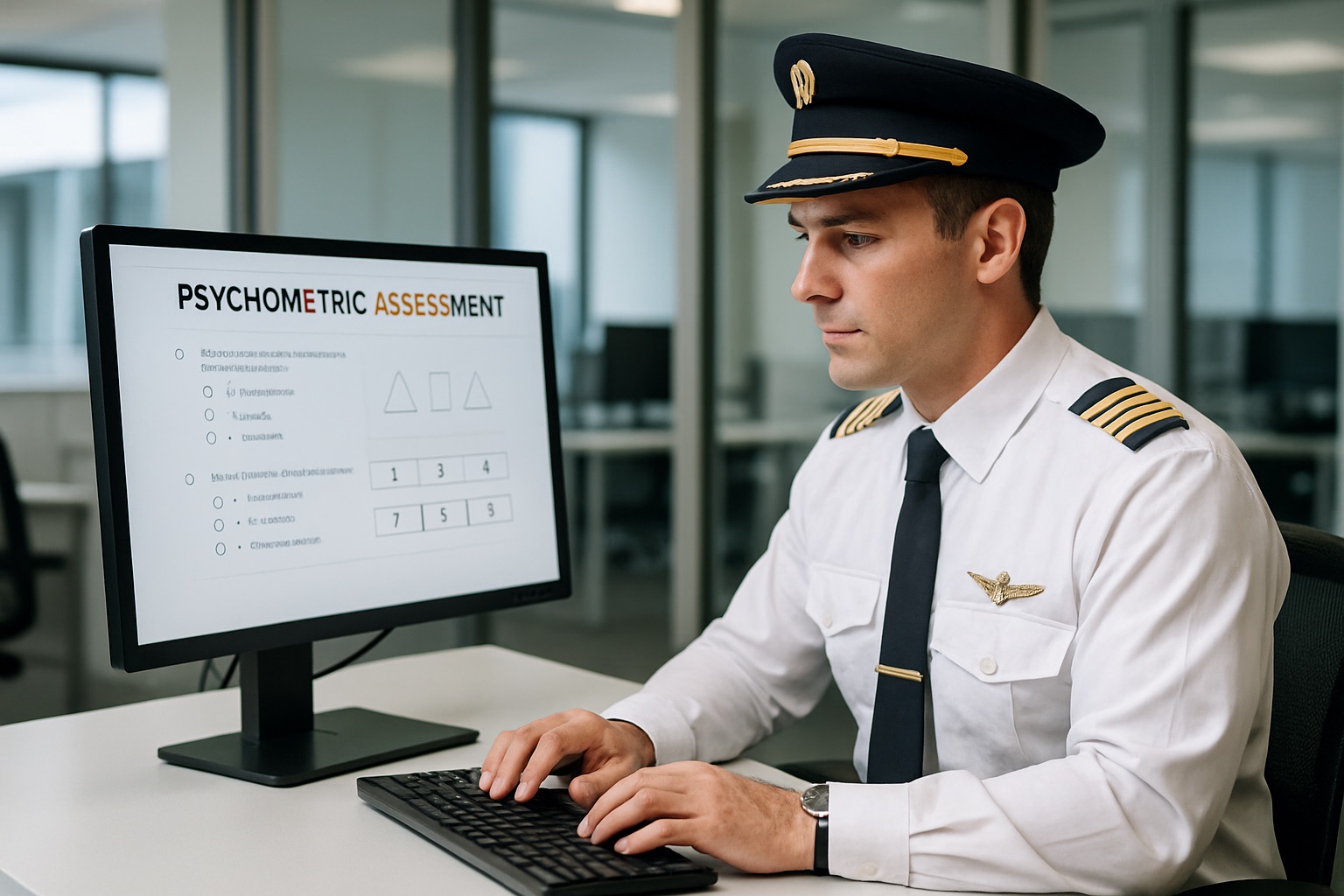
The COMPASS test — Computerised Pilot Aptitude Screening System — is one of the most significant hurdles in the airline pilot selection process. Used by Emirates and other major carriers, it's designed to assess the cognitive abilities that matter most in the cockpit: processing speed, spatial awareness, multi-tasking, and decision-making under time pressure.
Unlike a knowledge exam, you can't pass COMPASS by memorising answers. But you can absolutely improve your performance through targeted practice. Here's what you need to know.
What Is the COMPASS Test?
COMPASS is a computer-based aptitude battery specifically designed for pilot selection. It typically consists of six sub-tests administered over approximately 2.5 to 3 hours. Each test has strict time limits, and difficulty often increases as you progress through the battery.
The test is administered in a controlled environment — typically at the airline's assessment centre. You'll sit at a computer workstation, and the interface will include both keyboard/mouse inputs and, in some versions, a joystick for psychomotor tasks.
Key point
COMPASS is norm-referenced, meaning your scores are compared against a population of other pilot candidates. The airlines set their own cut-off thresholds, and these aren't publicly disclosed. Your goal is to perform as well as you can across all sub-tests — there's no way to "target" a passing score.
What COMPASS Measures
Each sub-test targets a different cognitive domain. While the exact test names and formats can vary between versions, the core areas assessed are consistent:
Spatial Orientation
Can you mentally rotate objects, interpret three-dimensional relationships, and maintain awareness of your position in space? This maps directly to instrument interpretation and situational awareness in flight. Tasks typically involve matching rotated shapes, interpreting compass headings after turns, or identifying the correct view from a described position.
Multi-Tasking
Can you manage multiple information streams simultaneously? This is arguably the most flight-relevant section. You may be asked to monitor instruments, respond to audio cues, and perform tracking tasks — all at the same time. The workload increases progressively, testing where your capacity ceiling lies.
Problem-Solving and Logical Reasoning
Can you identify patterns, apply rules, and reach conclusions under time pressure? These tasks assess your ability to work through novel problems quickly — a skill that maps to handling abnormal and emergency procedures in the cockpit.
Information Processing Speed
Can you absorb, interpret, and act on new information rapidly? You'll face tasks that require quick reading, data extraction, and decision-making from presented information — similar to the demands of reading NOTAMs, interpreting weather, or processing ATC instructions.
Psychomotor Coordination
Can you maintain precise control inputs while simultaneously managing cognitive tasks? Some COMPASS versions include a tracking task where you must keep a cursor centred while processing information or making decisions — a direct analogue to hand-flying while managing other cockpit duties.
Memory and Attention
Can you hold information in working memory while performing other tasks? Short-term memory recall, digit span, and attention-to-detail tasks assess the mental workspace you have available during complex operations.
How to Approach Each Section
The COMPASS test rewards a specific mindset. Here's how to approach it:
- Read the instructions carefully. Each sub-test begins with instructions and usually a practice round. Use this time. Understand exactly what's being asked before the clock starts.
- Pace yourself. Most sub-tests are time-limited. If you get stuck on a question, move on and come back if time permits. One skipped question is better than three rushed, incorrect answers.
- Stay calm during multi-tasking sections. The workload is designed to push past your comfort zone. Accept that you won't catch everything — the test is measuring how gracefully you manage overload, not whether you're perfect.
- Use a systematic approach for spatial tasks. Develop a consistent mental strategy for rotation problems. Many candidates find it helpful to identify one distinctive feature and track it through the rotation rather than trying to visualise the entire shape.
- Don't overthink logical reasoning. The first answer that seems right usually is. Second-guessing under time pressure costs you more than the occasional wrong answer.
Tip
The multi-tasking sections are where most candidates lose marks — not because the individual tasks are hard, but because managing them simultaneously is unfamiliar. The only way to get comfortable with this is to practise dual-task exercises regularly before your assessment.
FlightDeckIQ
Practice COMPASS-Format Tests Right Now
Spatial orientation, multitasking, memory, abstract reasoning — all built to match the cognitive domains COMPASS assesses.
Start Preparing Free
Common Pitfalls
These are the mistakes that cost candidates the most:
- Showing up unpractised. COMPASS measures aptitude, but aptitude can be trained. Candidates who practise spatial reasoning and multi-tasking exercises for several weeks before their assessment consistently outperform those who don't.
- Fixating on one task during multi-tasking. Just like in the cockpit, channelised attention is a failure mode. Practise switching your attention rapidly between tasks rather than completing one perfectly before moving to the next.
- Panicking when overloaded. The test is designed to find your ceiling. When you feel overloaded, prioritise the tasks you can manage and accept degraded performance on the rest. This is exactly what good pilots do — and assessors know it.
- Neglecting sleep and physical condition. Cognitive performance drops significantly with poor sleep. Arrive well-rested. This isn't soft advice — it's the single highest-impact preparation strategy for an aptitude test.
- Ignoring the practice rounds. The practice rounds aren't just warm-ups — they establish the mental model for each test. Take them seriously.
How to Practise Effectively
Since COMPASS tests cognitive skills rather than knowledge, your preparation should focus on training those skills:
- Spatial reasoning: Practice mental rotation exercises, compass heading problems, and 3D visualisation tasks daily. Even 15 minutes a day for a few weeks makes a measurable difference.
- Multi-tasking: Use dual-task training apps or exercises. Anything that requires you to monitor one stream of information while responding to another will build the capacity you need.
- Processing speed: Timed maths problems, rapid data extraction exercises, and speed reading drills all train the underlying ability.
- Psychomotor: If available, practise tracking tasks — keeping a cursor on target while performing a secondary cognitive task. Flight simulator practice with manual flying under workload can also help.
How FlightDeckIQ maps to COMPASS
- The Personality Questionnaire module helps you understand the behavioural profile airlines are looking for — distinct from COMPASS but part of the same psychometric assessment phase
- The Multitasking Test module trains dual-task performance under time pressure — directly relevant to COMPASS multi-tasking sections
- FlightDeckIQ's aptitude modules are designed to build the specific cognitive skills COMPASS measures, not to replicate the exact test
FlightDeckIQ
The Most Thorough COMPASS Preparation Available
FlightDeckIQ combines aptitude test practice with personality profiling and CBI preparation — everything you need in one place.
Start Preparing Free
"You can't cram for COMPASS — but you can train for it. Consistent daily practice on spatial reasoning, multi-tasking, and processing speed will shift your performance more than any last-minute study session."
Train the Skills That COMPASS Measures
FlightDeckIQ's aptitude training modules are built to develop the cognitive skills that pilot aptitude tests assess — spatial reasoning, multi-tasking, and processing speed. Start training today.
Start Your Free Trial →
← Back to all articles
|
View all guides